
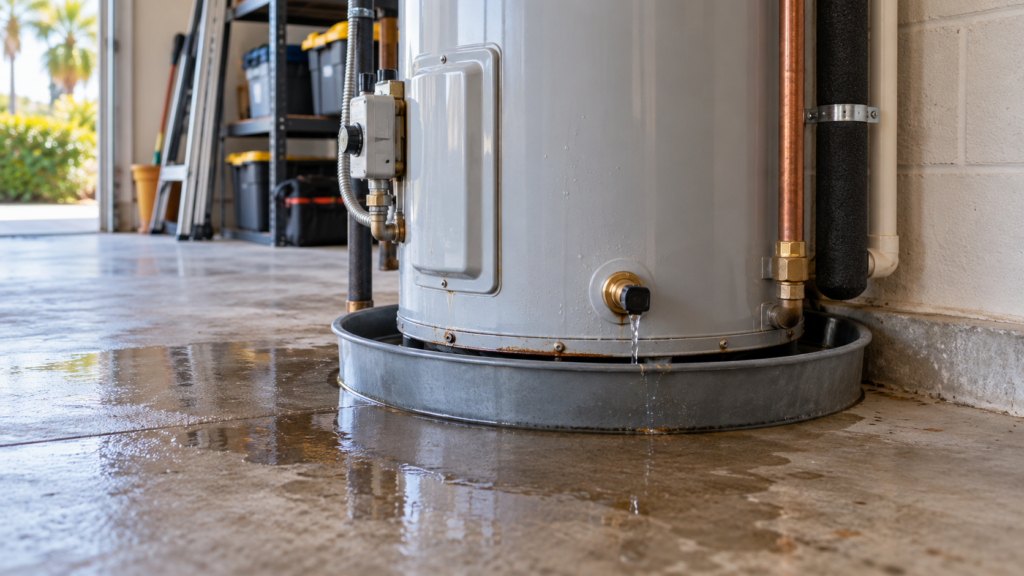
A puddle under the water heater is one of those discoveries that makes your stomach drop. The good news: a water heater leaking from the bottom isn’t always a dead tank. Sometimes it’s a loose drain valve, a relief valve doing its job, or plain condensation. Sometimes, though, it means the tank itself has rusted through and is about to let go.
As Central Florida turns a little cooler in late fall and winter, water heaters work harder, and that’s when we see a jump in leak calls across Orlando, Orange City, Palm Bay and Ocala. Here’s how to find where the water is coming from, what to do in the first ten minutes, and when it’s time to call a licensed plumber.
First: What to Do If Your Water Heater Is Leaking From the Bottom
Before you play detective, protect your home. Take these steps in order:
- Cut the power or gas. For an electric unit, switch off the water heater’s breaker. For a gas unit, turn the gas control knob to “Off” or “Pilot.” Never run a heater that may soon be empty.
- Shut off the cold water supply. Close the valve on the cold inlet pipe at the top of the tank. This stops more water from entering the tank and keeps the leak from getting worse.
- Contain the water. Mop up, move boxes and anything stored nearby, and put towels around the base. If the leak is heavy, attach a garden hose to the drain valve and drain the tank to the outdoors once the water has cooled.
- Look before you touch. Water coming out of a tank can be scalding. Let things cool before you put your hands near the valves.
- Take a photo of the label. The rating plate lists the model and serial number, which helps a plumber quote a repair or replacement fast.
If water is spreading quickly or you can’t find a shutoff, call our 24/7 emergency plumbing team. We answer around the clock.
5 Common Reasons a Water Heater Leaks From the Bottom
Water always runs downhill, so a leak that shows up at the base can start almost anywhere on the unit. These are the five sources we find most often.
1. A Loose or Failing Drain Valve
Every tank-type water heater has a drain valve near the bottom, used for flushing out sediment. Over time these valves loosen, wear out, or get stuck slightly open, especially plastic ones. Look for drips coming from the spout or around the threads where the valve meets the tank. A water heater leaking from the drain valve is usually a quick, inexpensive fix. Sometimes snugging it closed (or capping it) stops the drip; a worn valve can be swapped out without replacing the heater.
2. The Temperature and Pressure Relief Valve
The temperature and pressure (T&P) relief valve is a safety device on the top or upper side of the tank. A discharge pipe runs from it down toward the floor or drain pan, so when it releases water, the puddle shows up at the bottom of the heater even though the problem starts higher up.
A standard T&P valve opens when tank pressure reaches about 150 psi or the water reaches about 210°F. If yours is dripping, it may be:
- Responding to water pressure that’s too high coming into the house
- Reacting to thermal expansion because the home has no working expansion tank
- Worn out or clogged with mineral debris so it no longer seals
- Signaling a thermostat that’s overheating the water
A leaking relief valve is a warning, not just a nuisance. Never cap or plug the discharge pipe. That valve is what keeps a tank from building dangerous pressure. Have a plumber test the pressure and replace the valve if needed.
3. Condensation (Especially on Gas Units)
On a gas water heater, hot combustion gases meet the cold steel of a freshly refilled tank, and moisture can drip down onto the burner area and floor. This is most common after a lot of hot water has been used or on cooler mornings. Condensation usually stops once the tank is fully up to temperature. If the water keeps coming hours later, or you see rust or scorch marks near the burner, it’s something else.
4. Loose Fittings or a Leaking Supply Line
Supply lines and fittings on top of the heater can drip down the side of the jacket and pool at the base, which makes it look like the tank is leaking. Dry the top of the heater with a paper towel and watch for fresh beads of water at the inlet, outlet and connectors. Our earlier guide on when to replace your water heater covers how these top-of-tank leaks fool a lot of homeowners.
5. A Cracked or Corroded Tank
This is the one nobody wants. Inside every tank, minerals settle to the bottom as sediment. Over the years that sediment, along with normal corrosion, eats away at the steel. Hard, mineral-heavy water speeds the process up. Once the inner tank rusts through, water seeps out from under the jacket at the base, and there’s no repair for that.
Signs it’s the tank:
- Water is coming from under the heater, not from a valve or fitting
- You see rust stains, flaking metal or rusty water at the base
- Your hot water looks rusty or discolored
- The heater is rumbling or popping (a sign of heavy sediment)
- The unit is 10 years old or more
How to Tell Where Your Water Heater Leak Is Coming From
Dry everything off with towels, then check each spot in this order:
- Top of the tank: inlet, outlet and supply line connections
- T&P valve and its discharge pipe: feel the end of the pipe for moisture
- Drain valve: the spout and the threads where it enters the tank
- Burner area (gas units): droplets that disappear once the tank heats up point to condensation
- Base of the tank: water that keeps returning with no other source usually means the tank itself
If the floor is wet but the water heater is completely dry, the water may be coming from somewhere else, such as an AC drain line, a nearby pipe, or even a slab leak under your foundation.
Is a Leaking Water Heater Dangerous?
It can be. The biggest risks are:
- Water damage: a 40- or 50-gallon tank that fails can flood a garage, laundry room or closet, ruining drywall, flooring and stored belongings.
- Scald burns: water at the bottom of a working tank can be very hot.
- Pressure problems: a relief valve that’s leaking because of high pressure or overheating should be looked at right away.
- Mold: slow leaks in Florida’s humidity can lead to mold behind walls and under flooring.
- Gas safety: if you smell gas near a gas water heater, leave the house and call your gas utility or 911 from outside.
Florida’s plumbing code calls for a drain pan under tank-type water heaters installed where a leak would cause damage, at least 1.5 inches deep (and a plastic pan can’t go under a gas unit). A pan won’t stop a leak, but it buys you time. If your heater sits in a closet or garage with no pan, that’s worth fixing during your next service visit.
Repair or Replace a Water Heater Leaking From the Bottom?
Here’s the general rule our plumbers use:
- Repair when the leak is from a drain valve, T&P valve, fitting or supply line, and the tank is in good shape.
- Replace when the tank itself is leaking, the unit is near or past the end of its expected life, or you’re facing repeat repairs.
According to the U.S. Department of Energy, a typical storage water heater lasts about 10 to 15 years, and heavy sediment can shorten that. Not sure how old yours is? The serial number on the rating plate usually encodes the manufacture date, and we’ve put together step-by-step serial number guides for several common models.
If you’re replacing, it’s a good time to think about what comes next. Our team installs and repairs traditional tank water heaters and tankless water heaters, which don’t have a large tank to rupture. If hard water helped kill your last unit, adding a whole-home water softener can help the next one last longer.
How to Keep Your Next Water Heater From Leaking
- Flush the tank once a year to clear out sediment (more often if you have hard water).
- Have the anode rod checked every few years; it corrodes so the tank doesn’t.
- Test the T&P valve annually and replace it if it drips or sticks.
- Check your home’s water pressure and add an expansion tank if your system needs one.
- Keep a drain pan under the heater with a drain line that goes somewhere safe.
- Look at it once a month. A 10-second glance at the base catches slow leaks early.
Frequently Asked Questions
How long will a water heater last once it starts leaking from the bottom?
If the tank itself is leaking, there’s no safe way to predict it. It might drip for weeks or fail all at once. Treat a leaking tank as an urgent replacement and shut off the water supply in the meantime. If the leak is from a valve or fitting, the heater can often be repaired and keep running for years.
Should I turn off my water heater if it is leaking?
Yes. Shut off the power (breaker) or gas, then close the cold water supply valve at the top of the tank. That stops the leak from getting worse and protects the heating elements or burner from running on an empty tank.
Can I still shower if my water heater is leaking?
If it’s a small drip from a drain valve and the tank is otherwise fine, you may be able to use hot water briefly until a plumber arrives. If the tank itself is leaking or the relief valve is discharging, turn the heater off and wait. Using it can make the leak worse.
Why is my water heater leaking from the drain valve?
Drain valves loosen over time, wear out, or don’t fully close after the tank has been flushed, often because sediment gets caught in the valve seat. A plumber can usually flush the debris out or replace the valve without replacing the water heater.
How much does it cost to fix a leaking water heater?
It depends on the source. Replacing a drain valve or relief valve is a relatively small repair, while a leaking tank means a full replacement. We’ll find the source and give you an upfront price before any work starts.
Water Heater Leaking? Call First Quality Plumbing
First Quality Plumbing has helped Central Florida homeowners since 1998, with licensed, bonded and insured plumbers available 24 hours a day, 7 days a week. Whether it’s a dripping valve or a tank that’s given out, we’ll diagnose the leak and walk you through your options honestly.
Call the office nearest you, 24/7:
- Orlando: 407-826-4062
- Orange City: 386-775-0909
- Palm Bay: 321-253-3939
- Ocala: 352-808-0028
Prefer to book online? Schedule an appointment or contact us and we’ll get a plumber out to you.

Christopher Evers is part of the team at First Quality Plumbing & Irrigation Inc., a trusted Florida plumbing company serving residential and commercial customers with professional plumbing repair, installation, and maintenance services. First Quality Plumbing operates under Florida Certified Plumbing Contractor License CFC050566, which is listed as current and active with the Florida Department of Business & Professional Regulation. Christopher is committed to helping customers receive honest guidance, quality workmanship, and dependable plumbing solutions throughout Central Florida.