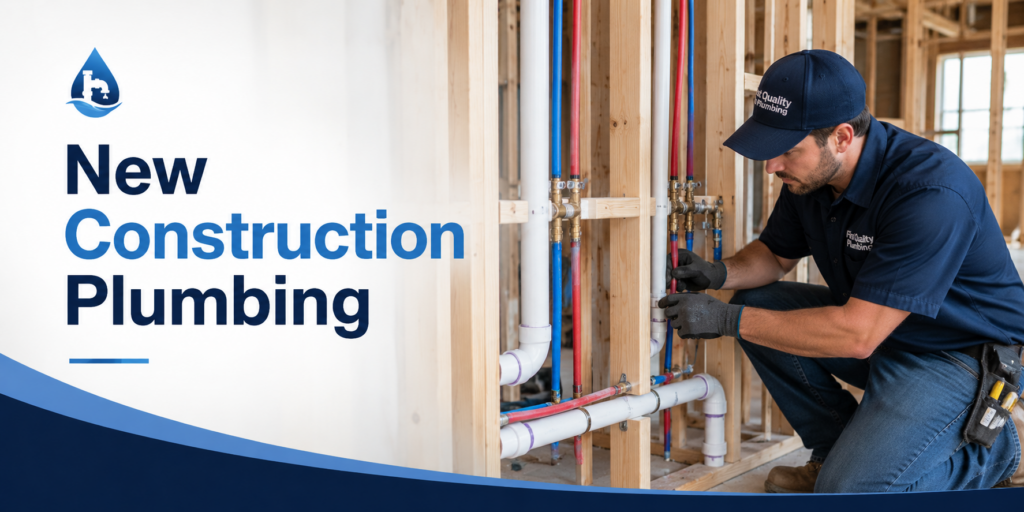
Building a new home in Central Florida is one of the biggest investments you’ll ever make, and the plumbing system underneath it all is not the place to cut corners. New construction plumbing is completely different from repair or remodel work — it starts before the concrete is poured and doesn’t finish until the last faucet is tested and inspected. At First Quality Plumbing, we work directly with homeowners, custom builders, and general contractors throughout Winter Garden, Windermere, Ocoee, Clermont, and the greater Orlando area to make sure every new build gets a plumbing system that’s efficient, code-compliant, and built to last for decades.
This page covers everything you need to know about how new construction plumbing works, what the process looks like from start to finish, what it costs, what’s required under Florida building code, and what to look for when hiring a plumbing contractor for your project.
What Is New Construction Plumbing?
New construction plumbing refers to the complete installation of a plumbing system in a structure being built from the ground up. Unlike a repair call or a remodel, there is no existing plumbing to work around — everything is designed, permitted, and installed fresh. That includes the water supply lines that bring clean water in, the drain-waste-vent (DWV) system that carries wastewater out, the gas lines (where applicable), the water heater setup, and all the fixtures like sinks, toilets, showers, and faucets that get connected at the end.
The process is divided into distinct phases that align with the broader construction schedule. Plumbers don’t just show up once — they typically mobilize at multiple stages of the build, coordinating with framers, electricians, HVAC contractors, and inspectors to keep the project moving on schedule. Getting the plumbing right at each stage protects the homeowner from expensive problems down the road, because once the walls and floors are closed up, fixing a mistake means tearing things back open.
The Three Phases of New Construction Plumbing
Every new residential construction plumbing project follows the same general sequence, regardless of the size or complexity of the home. Understanding these phases helps homeowners and builders know what to expect and when to expect it.
Phase 1: Rough-In Plumbing
Rough-in plumbing is the foundation of the entire system. It happens after the foundation is set and framing is complete, but before any walls or floors are closed in. This is when all the critical underground and in-wall work gets done — and because none of it will be visible once construction continues, it has to be right the first time.
During rough-in, our crews handle:
- Underground pipe installation and trenching — For slab foundations (which are extremely common in Florida), drain lines, water supply lines, and sewer connections must be placed in the ground before the concrete is poured. These lines must be accurately positioned, properly sloped for drainage, and sleeved where they penetrate the slab to prevent future cracking and movement.
- Drain-waste-vent (DWV) system routing — Every sink, toilet, shower, and appliance connection requires both a drain line and a vent line. Vent lines run up through the wall framing and out through the roof, allowing air into the system so water drains properly and sewer gases escape safely.
- Hot and cold water supply lines — Supply lines are run through the framing to every fixture location. In Florida, PEX tubing is the dominant material for residential supply lines due to its flexibility, corrosion resistance, and performance in Florida’s water chemistry. Copper is also used and performs well, but comes at a higher material cost.
- Stub-outs at fixture locations — Pipe ends are left protruding from walls and floors at every planned fixture location — bathrooms, kitchen, laundry room, utility areas — capped and ready for final connections later.
- Pressure testing — Before the rough-in inspection is scheduled, the system is pressure tested using air or water to confirm there are no leaks in any of the hidden lines.
Rough-in plumbing requires a passed inspection by the local building authority before insulation or drywall can be installed. In Orange County, Osceola County, Lake County, and the municipalities throughout Central Florida, this inspection is not optional — it is a required checkpoint built into the permitting process. We handle all coordination with the local building department so your timeline doesn’t stall.
Phase 2: Top-Out (Stack-Out) Plumbing
Once framing is complete and the roof is on but before walls and ceilings are sealed, the top-out phase extends the plumbing system upward and connects the rough-in work to the upper portions of the structure. This phase is sometimes called “stack-out” because it’s primarily about connecting and extending the vertical vent stacks that run from the drain lines up through the roof.
Top-out work includes:
- Vent stack installation and extension through the roof — Plumbers install and connect vertical vent pipes that penetrate the roof deck, allowing the DWV system to breathe. Without proper venting, drains gurgle, toilets don’t flush cleanly, and sewer gas can back up into living spaces.
- Upper-floor connections — For two-story homes, water lines and drain lines are extended to second-floor bathrooms, laundry rooms, and any other upper-level fixtures.
- Water heater and appliance rough-ins — The location and rough-in connections for the water heater, any recirculation systems, whole-house water filtration, and pressure reducing valves are set during this phase.
- Secondary pressure testing — Another round of pressure testing confirms all top-out connections are watertight before walls close in.
- Mid-project inspection — Similar to rough-in, this phase typically requires a passed inspection before wall finishing proceeds.
Phase 3: Final Plumbing (Trim-Out)
Final plumbing — sometimes called trim-out — happens at the very end of the construction process, after flooring is laid, tile is set, cabinets are installed, and painting is complete. This is the phase that transforms a rough plumbing framework into a fully operational system that a homeowner can actually use.
Final plumbing includes:
- Fixture installation — Sinks, faucets, toilets, showerheads, tub fillers, dishwashers, refrigerator ice maker lines, and all other visible plumbing fixtures are installed and connected.
- Water heater final connection and startup — The water heater is connected to supply lines and power or gas, filled, and commissioned. T&P relief valves are tested, and the unit is set to the proper temperature.
- Appliance hookups — Washing machine supply and drain connections, garbage disposal wiring connections, and any other appliance plumbing is completed.
- Final system test — Every fixture is run, every drain is tested, every toilet is flushed, and the water heater is verified before the final inspection is called.
- Final plumbing inspection — The local building inspector reviews the completed installation. A passed final plumbing inspection is required before a Certificate of Occupancy can be issued for the home.
New Construction Plumbing in Florida: What’s Different Here
Florida construction comes with a unique set of conditions that affect how new construction plumbing is designed and installed. If you’ve built in another state, or if your builder or plumber doesn’t have deep Florida experience, these factors can cause real problems.
- Slab foundations are the norm: The vast majority of Florida homes are built on concrete slabs rather than basements or crawl spaces. This means all underground drain and supply lines must be precisely placed before the pour — there’s no going back to adjust later. Accuracy during the underground phase is critical.
- Florida Building Code (FBC) compliance: All new construction plumbing must comply with the Florida Building Code, which is updated regularly and carries state-specific requirements on top of national model codes. Licensed plumbing contractors are required for all permitted new construction plumbing in Florida — this is not a DIY situation.
- Hard water and water chemistry: Central Florida’s water supply — particularly in well water areas and some municipal systems — is notably hard and high in minerals. This affects pipe material selection, water heater sizing, and whether a whole-house water treatment or softening system makes sense to build in from day one.
- Humidity and corrosion: Florida’s heat and humidity accelerate corrosion on exposed plumbing components. Material selection, proper pipe support, and appropriate sealants all matter more here than in drier climates.
- Hurricane and flood zone considerations: Homes in FEMA flood zones may have elevated first-floor requirements that affect the routing and protection of underground and below-grade plumbing.
- Permitting through local jurisdictions: Plumbing permits in Central Florida are pulled through the county or municipal building department — Orange County, Lake County, Osceola County, and individual municipalities like Winter Garden and Clermont each have their own process and inspection scheduling systems. We handle all permitting for the projects we manage.
New Construction Plumbing Cost: What to Expect
One of the most common questions we hear from homeowners and builders is: how much does new construction plumbing cost? The honest answer is that it depends on the size of the home, the number of bathrooms, the fixture selections, the pipe material, and the complexity of the layout. That said, here are the industry benchmarks that give you a realistic starting point.
Cost Per Square Foot
A widely used rule of thumb for new construction plumbing cost per square foot is roughly $4.50 to $8.00 per square foot for a complete residential installation. The lower end of that range applies to straightforward layouts with standard fixtures; the higher end reflects larger homes, more bathrooms, premium fixture selections, or added systems like tankless water heaters, whole-house filtration, or recirculation systems.
Rough-In Cost Estimates by Home Size
| Home Size | Estimated Rough-In Cost | Estimated Total Plumbing Cost |
|---|---|---|
| 1,000 sq ft (1–2 bath) | $4,500 – $6,500 | $7,000 – $10,000 |
| 1,500 sq ft (2 bath) | $6,500 – $9,000 | $10,000 – $14,000 |
| 2,000 sq ft (2–3 bath) | $8,000 – $12,000 | $13,000 – $18,000 |
| 2,500 sq ft (3–4 bath) | $10,000 – $15,000 | $16,000 – $24,000 |
| 3,000+ sq ft (4+ bath) | $13,000 – $20,000+ | $20,000 – $35,000+ |
These are general estimates for Central Florida residential new construction. Actual quotes will vary based on your specific plans, fixture selections, and site conditions. Contact First Quality Plumbing for a project-specific estimate.
What Drives the Cost Up
- Number of bathrooms and fixtures — Each additional bathroom adds supply lines, drain lines, vent lines, and fixture connections. More bathrooms = more material and more labor hours.
- Fixture quality and brand — Builder-grade fixtures are included in standard estimates. Upgrading to designer faucets, high-end shower systems, or freestanding tubs adds both fixture cost and sometimes additional installation complexity.
- Tankless water heaters — Tankless units require larger gas lines or dedicated electrical circuits and specific venting, which adds to the rough-in cost compared to standard tank heaters.
- Outdoor kitchens and pool/spa plumbing — Very common in Florida new construction, these add their own rough-in scope and permit requirements.
- Whole-house water filtration or softening systems — Worth considering at the build stage, since installation is far cleaner and less disruptive than retrofitting later.
- Two-story construction — Vertical runs and second-floor connections add material and labor compared to single-story footprints of the same square footage.
Pipe Material Options for New Home Plumbing
One of the most common questions during the planning phase is what type of pipe to use. In Florida new construction today, there are two primary options for water supply lines and one standard for drain lines.
PEX Tubing (Most Common in Florida)
PEX (cross-linked polyethylene) is by far the most widely used supply line material in Florida residential new construction. It’s flexible, which makes it significantly faster to install through framing, resistant to the kind of hard-water mineral scaling that affects copper over time, and resistant to freeze damage (less relevant in Central Florida, but a consideration in North Florida). PEX is also considerably less expensive per foot than copper, which helps keep new construction plumbing costs in check without sacrificing reliability.
Copper
Copper pipe has been used in Florida homes for decades and remains a completely viable, high-quality option. It’s more rigid than PEX (which means more fittings and more labor to install), carries a higher material cost, and can be subject to corrosion over time in Florida’s harder water areas. That said, copper has an extremely long track record, is compatible with all fixture types, and is preferred by some builders and homeowners for high-end custom construction.
PVC and ABS for Drain Lines
PVC (polyvinyl chloride) is the standard material for drain-waste-vent systems in Florida new construction. It’s affordable, durable, easy to work with, and performs well in the Florida climate. All drain lines, waste lines, and vent stacks in a new Florida home will almost universally be PVC.
Why New Construction Plumbing Requires a Licensed Florida Contractor
In Florida, all new construction plumbing work on permitted projects must be performed by or under the direct supervision of a licensed plumbing contractor. This isn’t just a legal requirement — it’s the practical reality that new construction plumbing involves too many interdependent systems, too many required inspections, and too much potential for expensive hidden failure to be approached any other way.
Here’s what a licensed new construction plumbing contractor actually brings to your project:
- Permit pulling and management — We obtain all required plumbing permits from the applicable building authority, manage inspection scheduling at each phase, and ensure all work passes before proceeding.
- Blueprint reading and system design — Before a single pipe is installed, we review the architectural and structural plans to map the optimal routing for supply, drain, vent, and gas lines that minimizes material waste and future maintenance issues.
- Trade coordination — New construction plumbing doesn’t happen in isolation. We coordinate with framers to ensure pipe penetrations don’t compromise structural members, and with electricians and HVAC contractors to avoid system conflicts in shared cavities.
- Code compliance at every phase — Florida Building Code requirements for plumbing include specific pipe sizing, slope requirements for drain lines, fixture unit calculations, venting requirements, and water heater installation standards. Getting these wrong means failed inspections and costly corrections.
- Warranty and accountability — Licensed contractors carry the required insurance, stand behind their work, and are accountable if something fails. This matters when you’re talking about a system that’s hidden inside your walls and under your floors.
Working With Builders and General Contractors
At First Quality Plumbing, we work as a subcontractor on new construction projects for custom home builders, production builders, and owner-builders throughout Central Florida. We understand that builders need a plumbing sub who shows up when they say they will, passes inspections on the first call, communicates proactively, and doesn’t create delays for the other trades. That’s exactly how we operate.
If you’re a builder looking for a reliable plumbing sub for your Central Florida projects, or a homeowner acting as your own general contractor and need a licensed plumber for your new build, First Quality Plumbing is ready to be that partner. We’ve worked on custom homes, spec builds, ADUs, and infill projects throughout Winter Garden, Windermere, Ocoee, Clermont, and the surrounding communities.
What’s Included in Our New Construction Plumbing Services
- Complete rough-in plumbing — underground, in-slab, and in-wall
- Drain-waste-vent (DWV) system installation
- Hot and cold water supply line installation (PEX or copper)
- Gas line rough-in (natural gas and propane)
- Water heater installation — tank and tankless
- Top-out and vent stack installation
- Fixture installation and final trim-out
- Whole-house water filtration and softening system installation
- Outdoor kitchen plumbing rough-in
- Pool and spa plumbing rough-in (in coordination with pool contractor)
- Pressure testing at each phase
- Permit pulling and inspection coordination
Ready to Get Started? Contact First Quality Plumbing
If you’re building a new home in the Winter Garden, Windermere, Ocoee, Clermont, or greater Orlando area and need a licensed plumbing contractor you can count on, we’d like to be part of your project. We work directly from your plans, coordinate with your build schedule, and handle every phase of new construction plumbing from the underground rough-in through the final trim-out and inspection.
Reach out to First Quality Plumbing today to discuss your new construction project and get a quote based on your specific plans and scope. We’re local, licensed, and ready to work.
Frequently Asked Questions — New Construction Plumbing
What is included in new construction plumbing?
New construction plumbing covers the complete installation of all plumbing systems in a home being built from the ground up. This includes the underground drain and supply lines installed before the slab pour, the in-wall rough-in of all drain-waste-vent and water supply lines, vent stacks, water heater installation, gas line rough-in (where applicable), and the final trim-out installation of all fixtures including sinks, toilets, faucets, showers, and appliances. The process also includes all required permit applications and building inspections at each phase.
How much does new construction plumbing cost in Florida?
For a typical Central Florida residential new construction project, plumbing costs generally run in the range of $4.50 to $8.00 per square foot for a complete installation. A 2,000-square-foot home with two to three bathrooms will typically fall somewhere between $13,000 and $18,000 for the full scope from rough-in through trim-out. Larger homes, more bathrooms, premium fixture selections, tankless water heaters, or added systems like whole-house filtration will increase the total. Contact us with your plans for a project-specific estimate.
What are the phases of new construction plumbing?
New construction plumbing is completed in three main phases. The first is rough-in plumbing, which happens after framing and before walls are closed — this is when all underground, in-slab, and in-wall pipes are installed and pressure tested. The second is top-out plumbing (also called stack-out), which connects the rough-in work to vertical vent stacks and upper-floor connections after the roof is on. The third is final plumbing (trim-out), which happens at the end of construction when all fixtures, appliances, and the water heater are installed, connected, and tested.
Do I need a permit for new construction plumbing in Florida?
Yes — all new construction plumbing in Florida requires a permit pulled from the local building authority (county or municipality). Inspections are required at the rough-in phase and the final phase at minimum, and a passed final plumbing inspection is required before a Certificate of Occupancy can be issued. In Florida, permitted new construction plumbing work must be performed by or under the direct supervision of a licensed plumbing contractor. First Quality Plumbing handles all permit applications and inspection coordination for our new construction projects.
What type of pipes are used in new home construction in Florida?
In Florida residential new construction today, PEX tubing is the dominant material for hot and cold water supply lines due to its flexibility, corrosion resistance, and compatibility with Florida’s water chemistry. Copper is also used, particularly in custom and high-end builds, and carries a longer track record at a higher material cost. For drain-waste-vent systems, PVC pipe is the universal standard in Florida new construction.
How long does the plumbing take on a new construction home?
The timeline depends heavily on the size and complexity of the home and how the overall construction schedule is sequenced. For a typical 2,000–2,500-square-foot single-family home, each plumbing phase — rough-in, top-out, and trim-out — generally takes anywhere from 2 to 5 days of active work per phase. The total elapsed time from start to finish spans the entire construction schedule, since plumbers return at multiple stages weeks or months apart. Inspection scheduling through the local building department also factors into the overall timeline.
Can I use a tankless water heater in a new construction home in Florida?
Yes, and new construction is actually the ideal time to install a tankless water heater because the gas line sizing, electrical requirements, and venting can all be designed into the rough-in from the start — rather than retrofitted into an existing home where those upgrades are more complex and expensive. Tankless water heaters deliver hot water on demand without the standby energy loss of a tank unit, which translates to lower utility bills over time. We install both gas and electric tankless systems and can size them correctly for your home during the planning phase.
What is rough-in plumbing in new construction?
Rough-in plumbing is the first major phase of new construction plumbing, occurring after framing and before walls and floors are closed in. It involves installing all the pipes, drain lines, vent lines, and water supply lines that will eventually be hidden inside the walls and under the floors of the home — everything except the final fixture connections. Rough-in plumbing must pass a building inspection before the next phase of construction can proceed. It is the most critical phase because errors in rough-in work are expensive to correct once the structure is closed.
Do you work with custom home builders in Central Florida?
Yes — First Quality Plumbing works as a plumbing subcontractor with custom home builders, production builders, and owner-builders throughout the Winter Garden, Windermere, Ocoee, Clermont, and greater Orlando area. We understand that builders need a plumbing sub who keeps pace with the construction schedule, passes inspections on the first call, and communicates proactively. If you’re a builder looking for a reliable plumbing partner for Central Florida new construction projects, we’d welcome the conversation.
What is the difference between new construction plumbing and remodel plumbing?
New construction plumbing involves installing a complete plumbing system in a structure with no existing plumbing — it starts from scratch, typically before any walls are closed. Remodel or renovation plumbing works within an existing structure, which means working around existing pipes, walls, and floors, often in tight spaces with limited access. New construction is generally more efficient to install because there are no obstructions, but it requires precise coordination with the construction schedule and multiple inspections. Remodel plumbing is often more labor-intensive per fixture because of the complexity of working in a finished space.
How do I choose a plumbing contractor for new construction in Florida?
The most important factors are: (1) the contractor must hold a valid Florida plumbing contractor license, (2) they should have documented experience specifically with new construction plumbing — remodeling experience doesn’t automatically translate, (3) they should handle their own permitting and inspection coordination, (4) they should be able to work from your architectural plans and communicate clearly with your general contractor or builder, and (5) they should be local to your area so they’re familiar with the local building authorities and inspection processes. First Quality Plumbing checks all of these boxes for Central Florida new construction projects.
First Quality Plumbing serves new construction projects throughout Winter Garden, Windermere, Ocoee, Clermont, Orlando, and surrounding Central Florida communities. Licensed, insured, and ready to build something right.
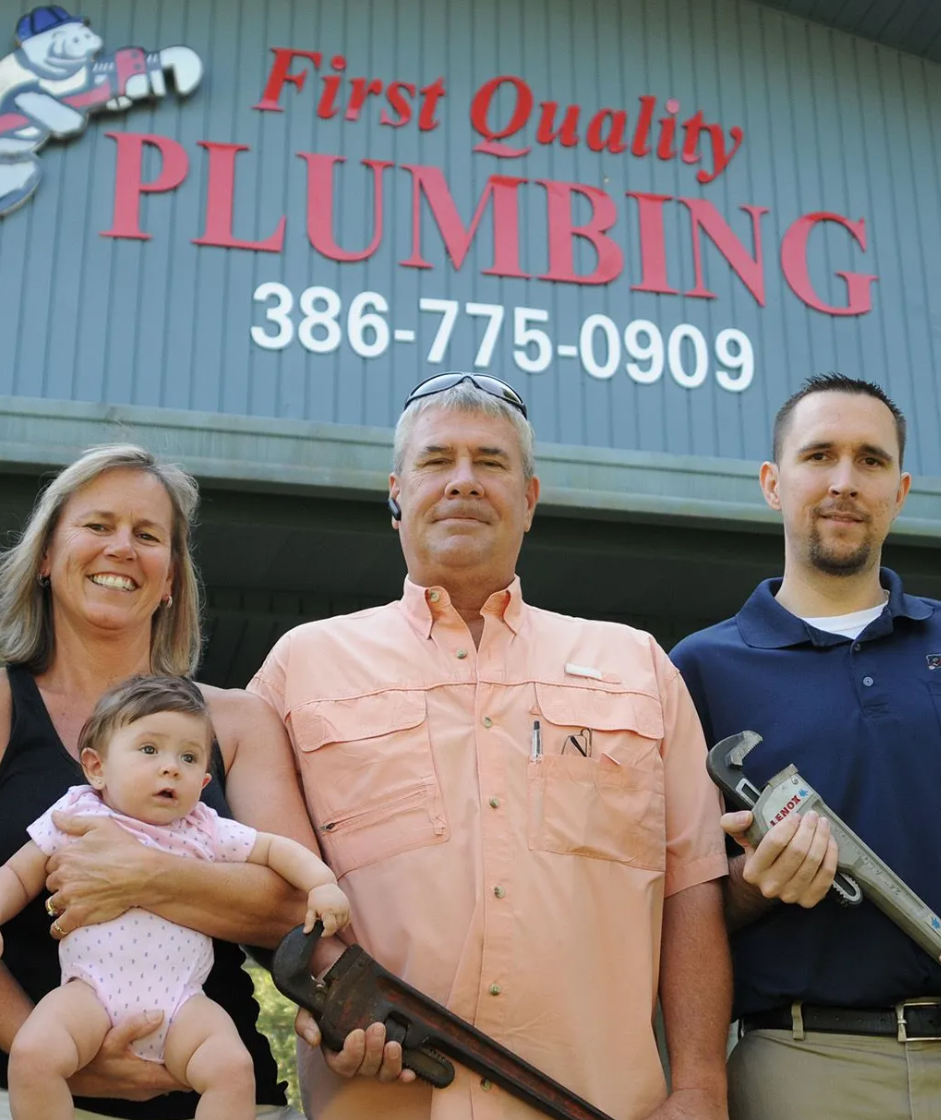
Christopher Evers is part of the team at First Quality Plumbing & Irrigation Inc., a trusted Florida plumbing company serving residential and commercial customers with professional plumbing repair, installation, and maintenance services. First Quality Plumbing operates under Florida Certified Plumbing Contractor License CFC050566, which is listed as current and active with the Florida Department of Business & Professional Regulation. Christopher is committed to helping customers receive honest guidance, quality workmanship, and dependable plumbing solutions throughout Central Florida.